
Garment Alert - Permanent and not so permanent pleats
Below is some technical advice provided by Howard Duffy, Technical Officer, on pleated fabrics with supporting information taken from the Drycleaning and Laundry Institute’s (DLI) Encyclopaedia of Drycleaning resource on pleats.
Background
The industry is seeing pleats coming back into fashion especially in dresses and gowns.
Reading and checking care instructions and fibre content labels at the counter before the cleaning will give you enough information to discuss with the customer.
Pleating is created in different ways, and the way they are created in the manufacture stage and the fabrics that the pleats are applied to determines how the pleats will present after cleaning.
Hand ironing, pattern cardboard and pleating machines are the most common methods.
A pattern of pleats is created in a form of two cardboard sheets, one sheet is placed on a table, the fabric laid flat then the second piece of cardboard is place om top. The cardboard is slowly gathered with the fabric sandwiched between, when the pattern is folded it is tied, left for a period then steamed and left again. When cooled, the parcel is undone, and the fabric removed with the pleats set in.
Chemical pleating uses a line of resin on the inside of the crease after pressing then set by heat in an oven. These pleats are most likely to last the life of the garment.
Polyesters and like fibres are going to hold a pleat much longer than other fibres, silk is the most likely to lose the pleating in a cleaning process. The DIA has dealt with two wedding dress complaints because of loss of pleating, both SILK fabrics, these claims are in the thousands of dollars.

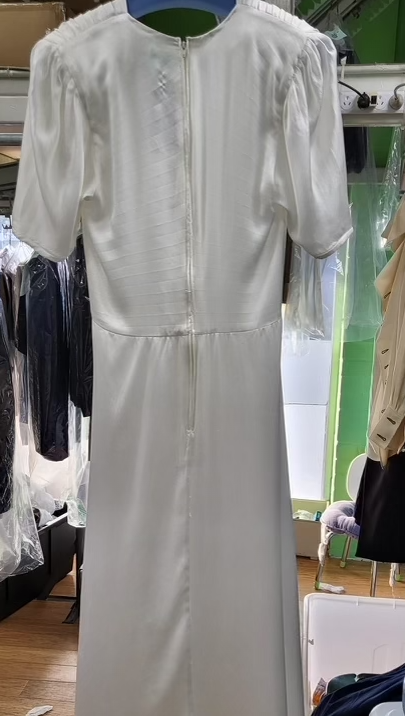
Dress before cleaning
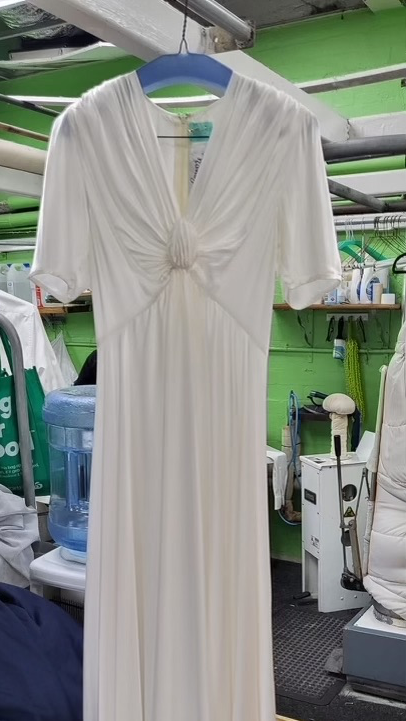
Dress after cleaning
Note - the drycleaner followed the care label
Cleaning
It is not usually recommended that pleated garments be wet cleaned or washed unless they have permanent pleats and care labels that recommend washing.
Drycleaners should handle pleated articles in the same manner as they would a fragile garment. Items should be placed in a net bag to help retain the shape of the pleats. Whenever possible, use a net bag that has been divided into two or more chambers. This can be done by taking a regular net bag and sewing a seam down the centre of it, making two pockets or chambers.
The garment should then be given a short run, a light extraction, and tumble dried at maximum temperatures of 120° F. Leave the garment in the bag during the entire cleaning, drying, and deodorizing process. The garment should be removed from the net bag immediately after the deodorizing cycle and carefully hung on a hanger to help keep the pleats in line and to keep the fabric from wrinkling.
If the cleaning / drying process temperatures do not exceed the temperature used to set the pleats initially then the pleats will survive the cleaning process, but it can be a good idea to hang dry rather than tumble dry.
Extreme care must be exercised in finishing garment with pleats. Remember, heat can be used to set the pleat in the manufacturing process. The application of too much heat and moisture can soften or remove the pleat. Do not place these garments on the steam-air finisher.
Setting pleats should be done with a hand iron. Be sure the hand iron is at the proper setting for the fibre type and the iron is moved rapidly across the fabric in a diagonal direction. Moving the iron straight up and down along the pleat may stretch the fabric, especially bias-cut fabrics. The use of too hot of an iron could cause fusing and melting of synthetic fibres or glazing of a finish on the fabric.
Remember wet spills during wear and spotting can also result in partial loss of pleating.
In some fabrics, school uniforms for example will hold enough pleat so that re setting them on the press is not such a difficult task.